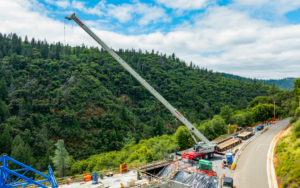
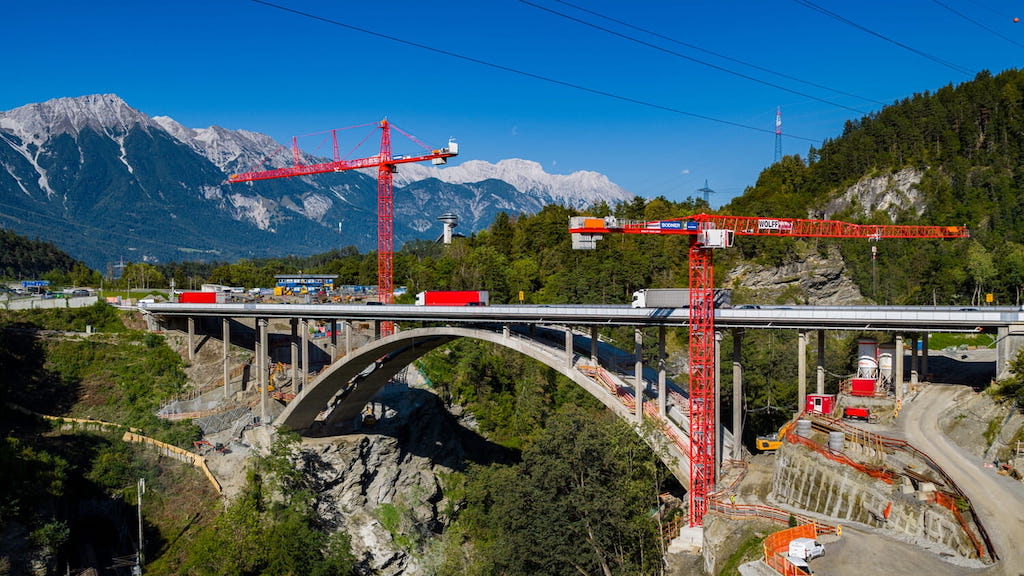
Two WOLFF tower cranes are working on the replacement of the Sill Bridge on the A13 motorway south of Innsbruck, Austria, where steep terrain, high-voltage lines and airport restrictions have created a demanding lifting environment.
Kufstein-based BODNER Group purchased a WOLFF 8060.25 Cross and WOLFF 8038.20 Clear for the project, marking the first WOLFF trolley jib cranes in its fleet.
Positioned on opposite sides of the Sill Gorge, the WOLFF 8060.25 operates with an 80-metre jib and 25-tonne lifting capacity, while the WOLFF 8038.20 uses a 70-metre jib with capacity up to 20 tonnes.
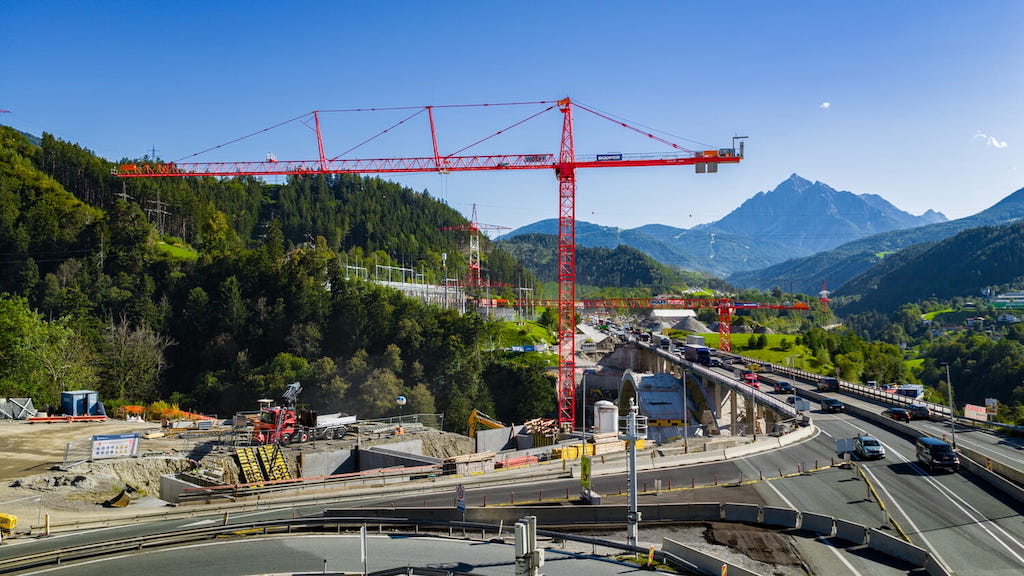
Installation itself required careful planning. Restricted space meant the jib of the WOLFF 8038.20 had to be assembled in two sections from two separate mobile crane positions. A 450-tonne mobile crane was brought in to erect the larger WOLFF 8060.25.
Foundation anchors presented another challenge, positioned around 14 metres into the steep slope and approximately 20 metres below the bridge abutment.
The two cranes will remain on site for around three years, handling formwork, concrete, machinery and other construction equipment during demolition of the existing bridge and construction of its replacement.
High-voltage lines cross the working area, while the safety zone of Innsbruck Airport extends to the project site. Both cranes therefore required specific operating permits and were equipped with aviation obstruction lighting.
“Projects like the Sill Bridge show that infrastructure construction is about more than just lifting capacity. What really matters is a carefully coordinated approach to crane selection, positioning and assembly,” said Dominik Zielinski, Sales Manager for Austria at Wolffkran.
The Sill Bridge forms part of the Brenner Motorway, a major transit connection between Austria and Italy. The existing structure, dating from the early 1960s, is being replaced in phases while motorway traffic remains operational.
“Naturally, the crane’s high lifting capacities were an important criterion for us. Equally important, however, was the support provided by the Wolffkran team, from planning to assembly,” said Jürgen Peer, Technical Manager at BODNER.
Completion of the new bridge is scheduled for late 2028.