
Zoomlion’s LW3600-240NB makes project debut in Shanxi wind farm
Zoomlion’s LW3600-240NB, described by the manufacturer as the world’s largest wind power tower crane, has completed its first project deployment at a 50 MW wind farm in Huguan County, Changzhi City, Shanxi Province, China. Working in the Taihang Mountains, the…
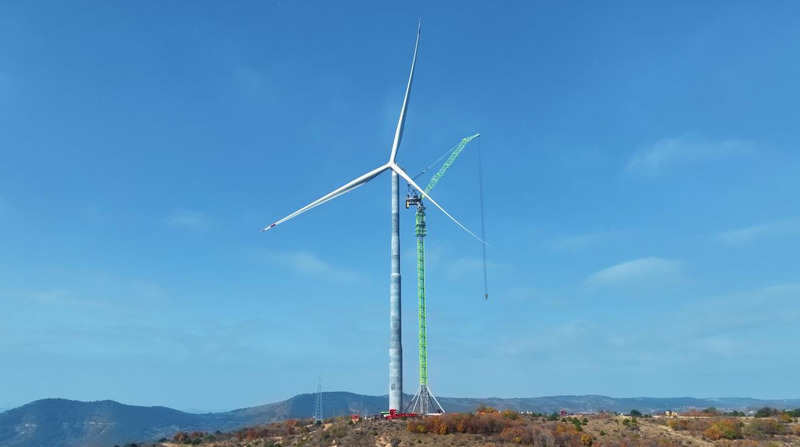
Zoomlion’s LW3600-240NB, described by the manufacturer as the world’s largest wind power tower crane, has completed its first project deployment at a 50 MW wind farm in Huguan County, Changzhi City, Shanxi Province, China.
Working in the Taihang Mountains, the tower crane lifted wind turbine blades to heights of more than 100 metres, supporting installation works on a project that will feature eight 6.25 MW hybrid-tower wind turbines.
The site presents difficult conditions for heavy lifting operations. Located at an average altitude of more than 1,400 metres, the wind farm is spread across mountain ridges, with some slopes approaching 20 degrees. According to Zoomlion, these conditions make it difficult for conventional large-tonnage cranes to secure suitable working areas and accurately position major components at a hub height of 160 metres.
Zoomlion said the LW3600-240NB was developed to address exactly these kinds of challenges. The crane offers a maximum lifting capacity of 240 tonnes and a maximum lifting height of 241 metres, enabling it to handle the installation requirements of hybrid-tower wind turbines above 10 MW. The company added that the crane’s large-angle goose-neck jib design allows nacelles weighing more than 100 tonnes to be lifted steadily in strong ridge-top winds, while fixed-radius lifting and precise hoisting technology help reduce alignment time at height.
The crane has also been designed to reduce site requirements and speed up relocation between turbine positions. Zoomlion said the LW3600-240NB requires a site footprint of 35 m by 55 m, or 1,925 square metres, giving contractors more flexibility in mountainous terrain and reducing land disturbance.
Its mast sections use a clamping-shoe pallet structure intended to simplify assembly and dismantling, while a movable pulley system removes the need for continuous support from an auxiliary crane. Under ideal conditions, the full relocation process – including dismantling, transport and reassembly – can be completed in as little as 32 hours.
With its first project now completed, the LW3600-240NB has made its operating debut on one of the more demanding types of onshore wind installation site, where lifting height, limited working space and steep terrain combine to test both crane design and project logistics.