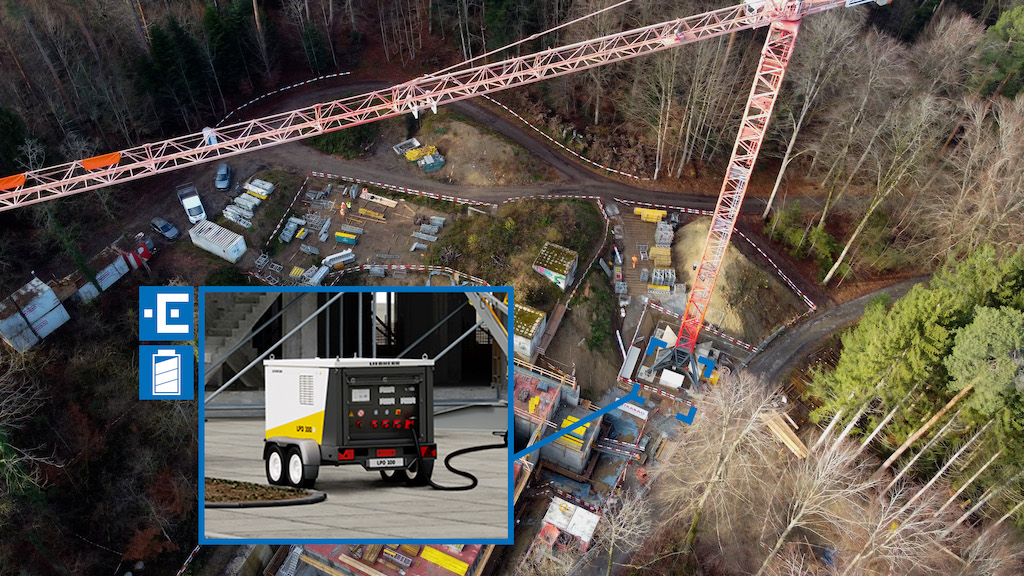
STRABAG AG has successfully utilised the Liebherr LPO 100 mobile battery energy storage system during the expansion of a drinking water reservoir near Lake Zurich, Switzerland, proving that major construction projects can operate efficiently without diesel generators.
The project, located in a forested area near Rüschlikon, involved the phased reconstruction of reservoir facilities that are more than a century old. With strict environmental and hygiene requirements in place, combined with a severely limited grid connection, securing a reliable power source was a key challenge. The Liebherr LPO 100 enabled quiet, emission-free operations while eliminating the need for costly grid expansion.
Despite being connected to a temporary CEE 16 A supply providing just 11 kW, the battery storage system continuously charged from the grid and delivered up to 110 kVA of peak power to cranes and site equipment. This ensured stable operations for more than five months and supported demanding activities, including concrete pours of up to 150 m³ per day.
Beat Spörndli, Site Manager at STRABAG AG, said the company was already familiar with the system from previous projects and that it proved essential in maintaining reliable crane operations and concrete pouring despite the limited power connection. He added that the solution removed the need for diesel generators and simplified site logistics.
The battery-powered system was particularly well suited to the sensitive forest environment thanks to its low-noise, emission-free operation. It also reduced maintenance requirements and eliminated the need for diesel fuel deliveries. Unlike conventional generators that run continuously, the LPO 100 supplies energy only when required, improving overall efficiency.
Over the course of the five-month project, STRABAG saved approximately 10,000 litres of diesel fuel and around CHF 17,700 in fuel costs compared with a conventional 70 kVA diesel generator. The company also reduced CO₂ emissions by approximately 27 tonnes.