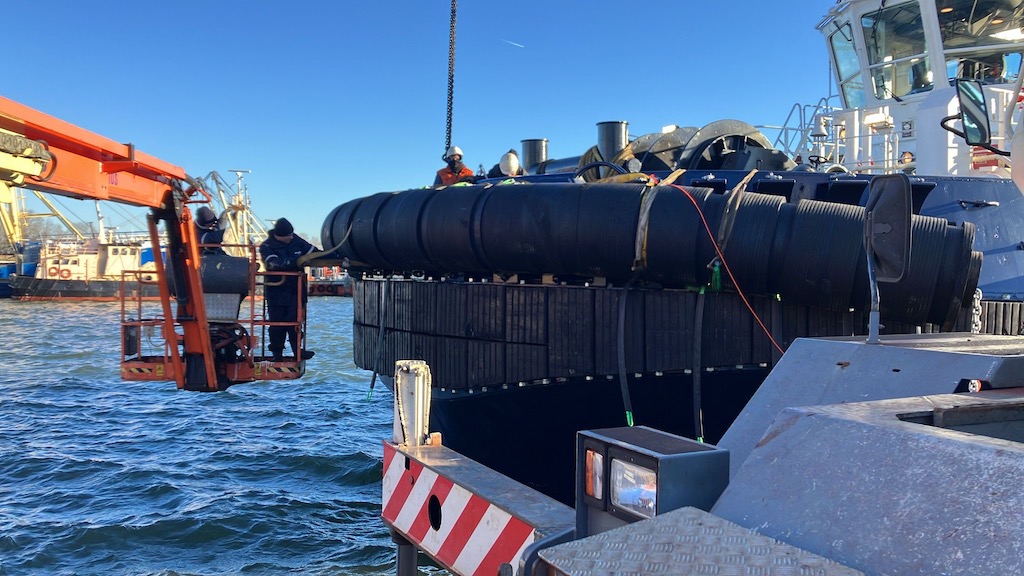
For tug operators, fender replacement is often seen as routine maintenance. But when vessel drawings are outdated or missing altogether, replacing fender systems can quickly become a costly exercise in guesswork. A recent project for Boluda Towage in Rotterdam shows how a service-led approach can turn that challenge into a logistics and engineering success story.
Working for three ASD tugboats, Bencros delivered replacement fender systems through a new rapid-response on-site service designed to minimise downtime, avoid installation risks and tailor solutions to actual vessel conditions rather than relying on legacy drawings.
The challenge is common across ageing fleets: modifications over time often mean original vessel drawings no longer reflect reality. Ordering replacement fenders based on incomplete data can lead to misfits, rework and unexpected time in drydock. For operators, that can mean expensive downtime.
To avoid that, Bencros applied a different model, measuring the vessels directly on site and designing solutions around what was physically there.
Each tug presented a different challenge.
For one vessel, dimensions were taken manually by a specialist fender engineer during drydock. For a second tug, where no proper marine fender configuration existed, Bencros deployed 3D scanning technology to generate a digital model, from which a tailored design was produced through its CAD system. Within a week, a custom replacement fender was manufactured and installed.
The third tug presented a transport challenge, requiring an unusually long replacement fender too large for conventional road transport. Bencros responded with a modular three-part design that could be transported efficiently and assembled seamlessly on site.
The turnaround was striking. Based on the measurements, the fenders were manufactured in three days and delivered from Bencros’ Slovakian facility within a further four days, seven days in total.
Ronald Tomassen, General Manager at Bencros, said the project demonstrated growing demand for more service-driven solutions. “This clearly fills a gap the market has been asking for,” he said. “It’s about delivering solutions that fit the vessel, rather than forcing vessels to adapt to standard products.”
Beyond speed, the project also incorporated a circular element. The existing fenders were removed, returned and recycled, with recovered rubber reused in the production of new systems — an approach aligned with Boluda’s wider sustainability goals.
For Boluda Towage, the benefits were immediate: no structural modifications, reduced downtime and lower lifecycle cost.
Fleet Manager Joren van Delft noted that finding a supplier willing to measure and engineer around the problem, rather than simply sell a product, was key to the project’s success.
The project also points to a broader shift in marine support services, where suppliers are increasingly expected to provide integrated engineering, fast response and lifecycle thinking alongside equipment supply.
For operators under pressure to maximise vessel availability, that shift may prove as important as the hardware itself.