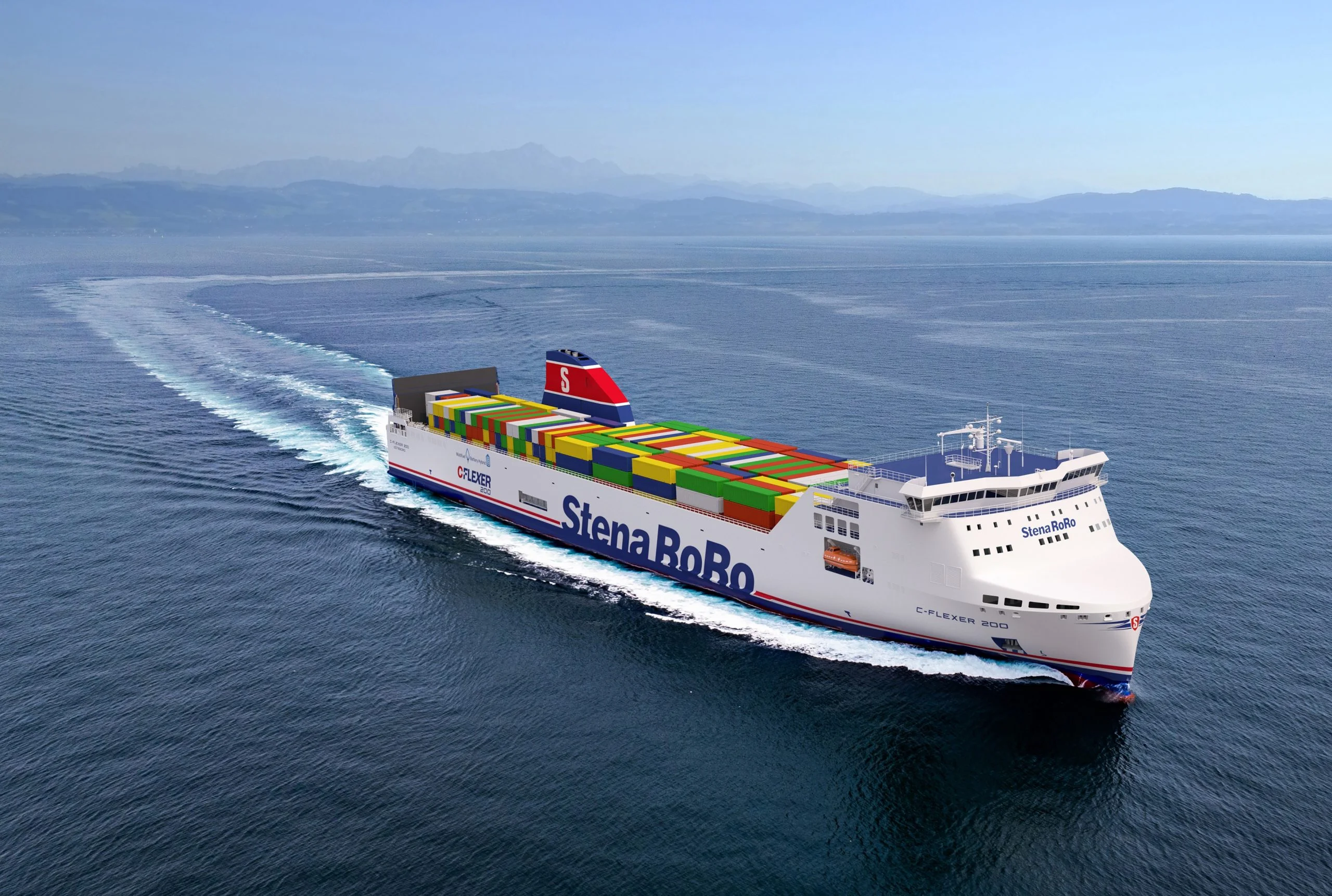
Stena RoRo has signed a landmark contract for a new series of next-generation RoRo vessels, placing firm orders for two C-Flexer ships with options for four more. The move strengthens the company’s long-term strategy to deliver flexible, future-ready RoRo tonnage to the global market. The vessels were developed by Stena RoRo in close collaboration with Italian naval architects NAOS Ship and Boat Design.
According to Per Westling, CEO of Stena RoRo AB, the project combines Stena RoRo’s market experience with NAOS’ expertise in designing fuel-efficient RoRo and RoPax vessels, resulting in ships built to meet current demands while remaining adaptable to future requirements.
The first two C-Flexer vessels are scheduled for delivery in March and June 2029, with any optional ships to follow at three-month intervals.
Construction will take place at China Merchants Industry (CMI) Weihai Shipyard, continuing a long-standing partnership between the two companies. Over the past decade, Stena RoRo has ordered 17 vessels at the yard. The relationship began in 2016 with four E-Flexer RoPax vessels and has since expanded to 15 vessels in that series, 12 of which have already been delivered. In addition, two RoRo vessels based on the Stena NewMax concept have also been completed there. Westling highlighted the cooperation with CMI Weihai as a key factor behind the successful delivery of tailor-made vessels to Stena Line and third-party operators, consistently meeting schedule and quality expectations.
The C-Flexer design focuses on operational flexibility and environmental performance. A refined hullform, multi-fuel engines and a scalable battery-hybrid system allow the ships to be progressively upgraded as technology and regulations evolve. In the longer term, the vessels are designed to operate fully on batteries, while the initial diesel-battery hybrid configuration ensures efficiency, redundancy and reduced emissions from day one.
Each vessel will measure 200 metres in length with a 31-metre beam, a deadweight of about 15,000 tonnes, a draft of 7.5 metres and a service speed of 21 knots, offering up to 4,750 lane metres in the four-deck configuration.