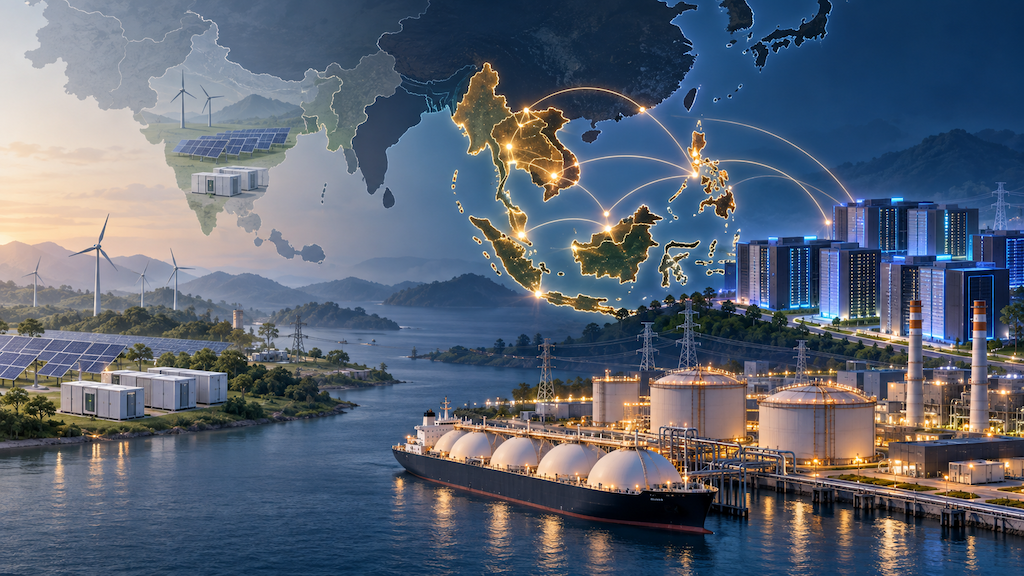
Rapid growth in hyperscale data centres is expected to create a significant new source of LNG demand across Southeast Asia, while South Asia is unlikely to offer the same opportunity, according to new research from Wood Mackenzie.
Southeast Asia’s data-centre capacity is forecast to more than triple from 2.8 GW today to 9.4 GW by 2035, with associated electricity consumption rising from 17 TWh to 57 TWh.
Wood Mackenzie believes combined-cycle gas turbines will remain one of the most viable technologies for providing the continuous power required by data centres, particularly while grid-scale battery storage remains commercially limited across much of the region.
Singapore represents one of the clearest LNG opportunities, with around 95% of its electricity currently generated from gas. As piped imports from Malaysia and Indonesia decline, the city-state is expected to become increasingly dependent on LNG.
Malaysia and Thailand are also identified as major growth markets. Malaysia already has around 3.9 GW of data-centre capacity under development, while declining domestic gas production is driving investment in additional LNG import infrastructure.
Thailand faces a similar transition, with LNG expected to account for more than half of its gas supply by 2035 as domestic production and pipeline imports decline.
“Malaysia and Thailand are at a turning point,” said Md Fadhlullah Omarali, Principal Analyst at Wood Mackenzie. “Data centre investment is growing quickly just as domestic gas output peaks and declines.”
The outlook differs sharply in India, despite data-centre capacity potentially reaching almost 12 GW by 2035. Wood Mackenzie estimates LNG-fired generation costs two to three times more than renewable power combined with battery storage, limiting gas’s ability to compete as a baseload source.
As a result, the expanding Southeast Asian data-centre market could provide LNG suppliers with a new structural source of long-term demand, particularly as regional domestic gas supplies decline.