
Nine WOLFF Cranes Tackle London Project
Wolffkran is playing a central role in the redevelopment of 1 Victoria Street in London, where nine WOLFF tower cranes are supporting one of the capital’s most technically challenging construction projects. The development will transform a former 1960s office building…

Wolffkran is playing a central role in the redevelopment of 1 Victoria Street in London, where nine WOLFF tower cranes are supporting one of the capital’s most technically challenging construction projects.
The development will transform a former 1960s office building into a modern low carbon workplace while retaining approximately 52 percent of the original structure and foundations. By reusing existing foundations and avoiding new piling works, the project significantly reduces embodied carbon.

Client: Mace/Stanhope
Cranes: 166 B and 3 x 355 b
The crane strategy has been divided into multiple phases and involves a total of nine WOLFF cranes. The first crane on site, a WOLFF 355 B luffing jib crane, supported demolition works for contractor Keltbray, handling heavy lifts including excavators, tracked loaders, generators and structural steel.
Following demolition, contractor Mace Construct installed four additional cranes, including one WOLFF 166 B and three WOLFF 355 B models, to support construction of the building core and superstructure.
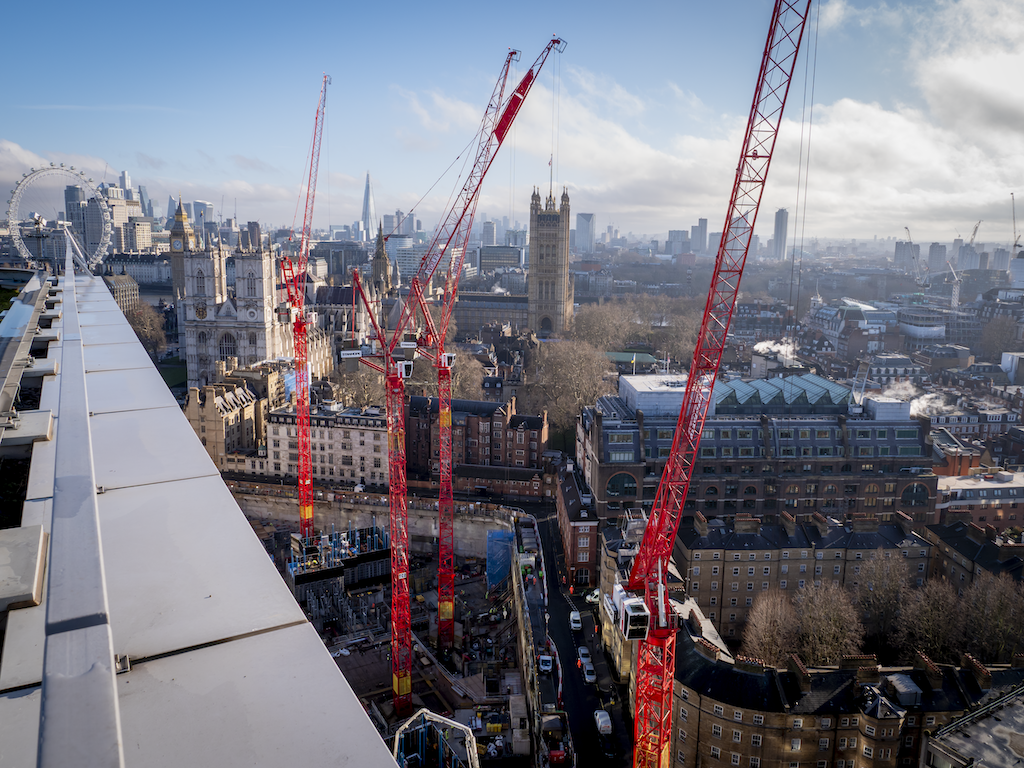
Client: Mace/Stanhope
Cranes: 166 B and 3 x 355 b
A major engineering challenge arose from the decision to reuse foundations that are more than 60 years old. Rather than installing cranes on new purpose built foundations, each crane had to be positioned directly above existing structural support points.
To overcome this, Wolffkran utilised its adaptable cross frame system, allowing support legs to be individually adjusted between six and ten metres in length. One crane required four different leg lengths within a single base structure to align with the available foundation supports.

The project will present further challenges during crane dismantling. With basement slabs being cast around the crane bases, conventional mobile cranes will not be able to access the equipment. Instead, dismantling will rely on ceiling hoists, low level forklifts and skating systems to safely remove crane components.
Later in 2026, four additional WOLFF luffing jib cranes will be installed on the roof to support construction of the upper floors, façade and building services.
The completed development is expected to be occupied in early 2028.