


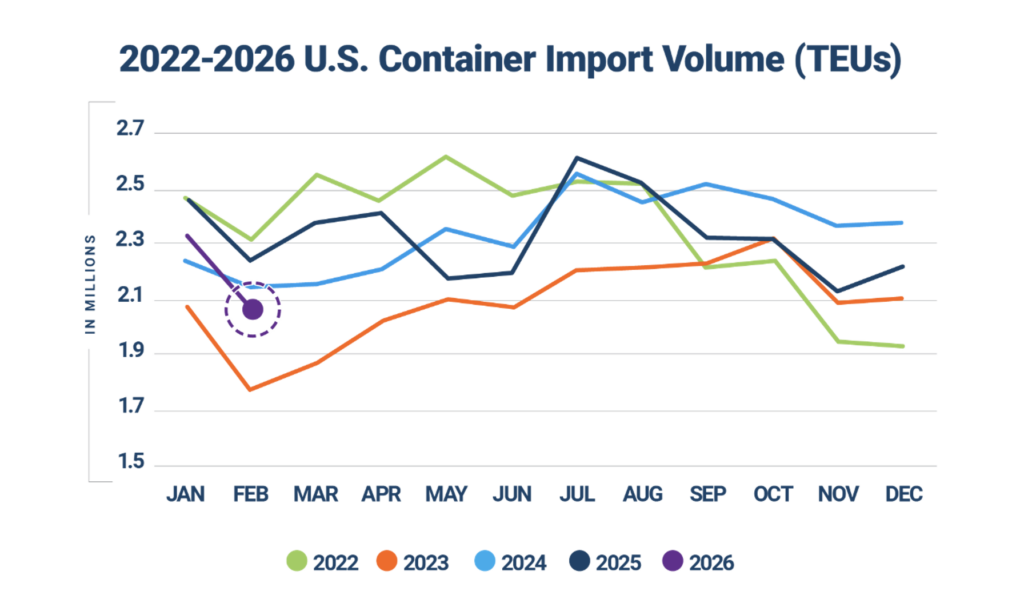
U.S. container import volumes declined in February 2026, reflecting typical seasonal patterns, according to the latest Global Shipping Report released by Descartes Systems Group. Total imports reached 2,093,422 teu, representing a 9.7 percent decrease compared with January.
Despite the monthly drop, volumes remained relatively strong in historical terms. Imports were 6.5 percent lower than February 2025 but still 17 percent higher than pre-pandemic levels recorded in February 2019. February 2026 ranks as the fourth-strongest February on record, indicating stable demand despite ongoing market uncertainty.
China-origin imports declined by 5.5 percent month-on-month after increasing 9.3 percent in January. Imports from several other major sourcing countries also fell, contributing to the overall slowdown in volumes. Vietnam recorded an 11.6 percent decrease, Thailand fell by 19.9 percent, India declined 17.5 percent and South Korea dropped 17 percent.
Only two of the top 10 countries of origin posted increases during the month. Imports from Germany rose by 5.5 percent, while Hong Kong recorded a marginal increase of 0.4 percent.
According to Descartes, port transit delays showed mixed but generally moderate changes in February, with no indication of widespread congestion across U.S. ports.
However, geopolitical tensions continue to influence global supply chains. Military conflict in the Middle East, changes to U.S. tariff policies and ongoing trade tensions are creating uncertainty for importers and logistics operators.
“While February volumes suggest underlying demand remains relatively stable, the military conflict in the Middle East, evolving U.S. tariffs and ongoing trade tensions have increased routing, cost and policy uncertainty for importers,” said Jackson Wood, director of industry strategy at Descartes.
The report concludes that supply chain planning is increasingly focused on risk management and flexibility as companies adapt to evolving geopolitical and trade conditions.