Liebherr, MAN Truck & Bus and Daimler Truck have demonstrated what a low-emission construction site could look like, using hydrogen-powered machinery and trucks in a live test deployment at a gravel plant in Munich.
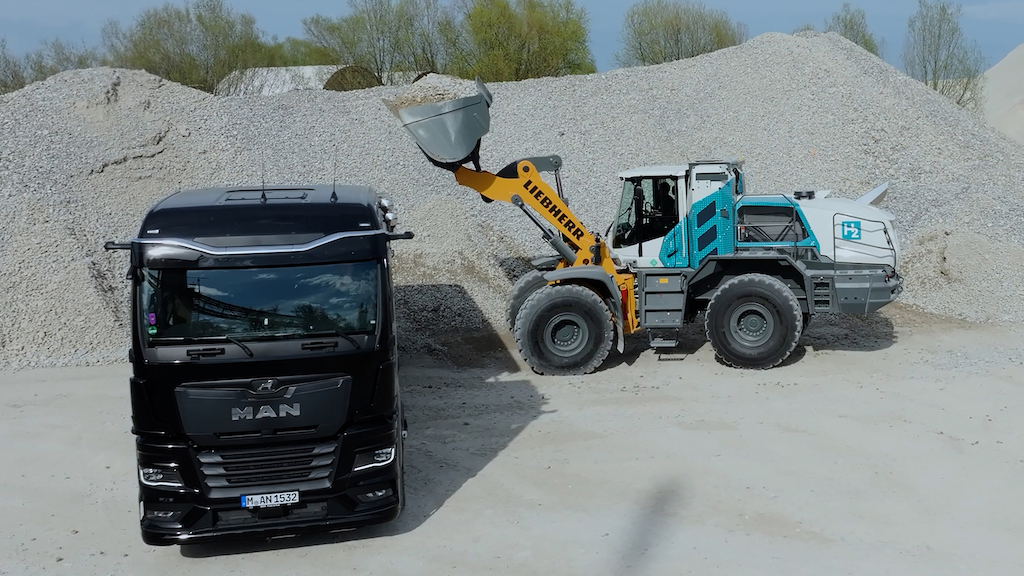
The operation brought together a Liebherr large wheel loader working alongside hydrogen-powered heavy-duty trucks from MAN and Daimler Truck. While loading and transporting gravel would normally be a routine task, the test marked an important milestone: all three machines operated using hydrogen combustion engines, enabling largely CO2-free performance while maintaining the working capabilities expected on demanding construction sites.
At the centre of the demonstration was the Liebherr L 566 H, the first prototype of a large wheel loader fitted with a Liebherr hydrogen engine. According to Liebherr, the machine can complete a full shift like a conventional diesel wheel loader and can be refuelled in around 10 to 15 minutes, allowing construction operations to continue with minimal disruption. The loader is currently one of several hydrogen wheel loader prototypes being tested with customers.

The deployment also included the production-ready MAN hTGX hydrogen truck, now available to order and produced in small series, as well as Daimler Truck’s development vehicle based on the Mercedes-Benz Arocs. Both manufacturers highlighted that hydrogen engine driving behaviour is comparable to diesel, with similar assistance systems and transmission functions, while Daimler Truck noted quieter operation.
The joint project was made possible through the Hydrogen Engine Alliance, a cross-industry interest group based in Karlsruhe, Germany. The partners argue that hydrogen propulsion can play a key role in decarbonising heavy-duty machinery where long operating cycles, heavy loads and long ranges make electrification difficult.
The companies stressed that wider adoption will depend on developing an effective hydrogen infrastructure and achieving fair hydrogen pricing across Europe.