
Canada’s construction sector is set for continued expansion, with forecasts indicating the market will reach CAD 261.3 billion by 2029, growing at an average annual rate of 3.2% across residential, commercial, industrial and infrastructure segments. The Canadian Construction Association has also highlighted planned federal infrastructure investments of around CAD 115 billion, including significant funding for local housing and transport projects, underlining construction’s role as a key economic driver.
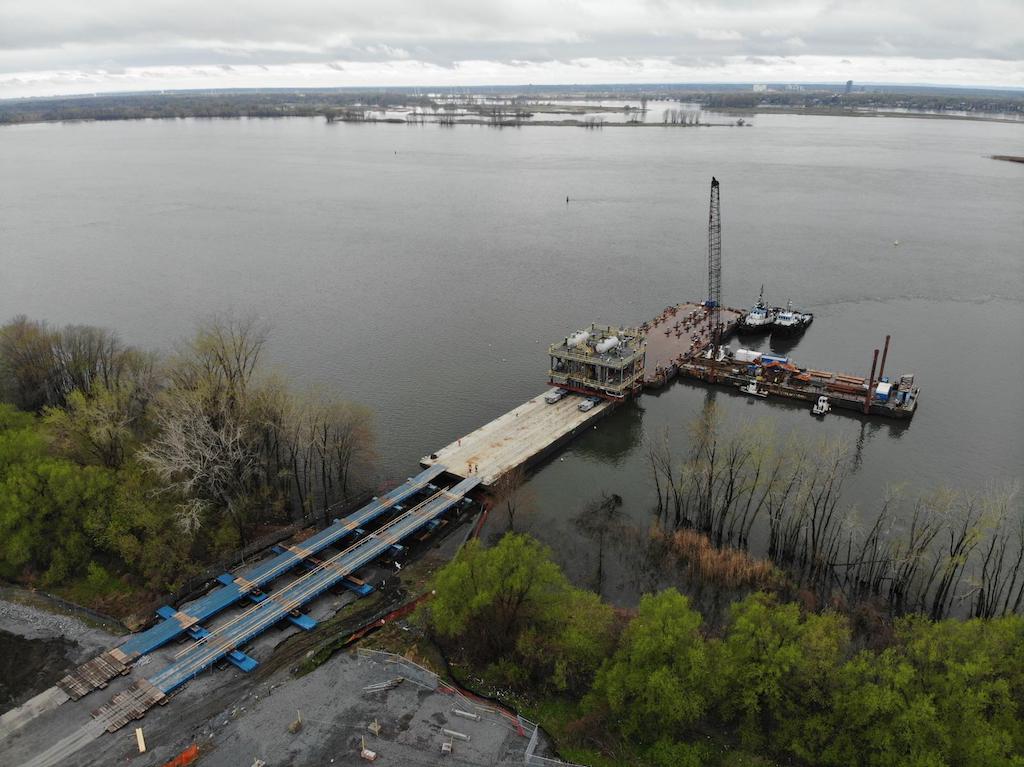
Against this backdrop, Sarens has completed a complex temporary bridge project at the Port of Bécancour in Québec, enabling the transport of large industrial modules under demanding site conditions. The heavy lifting and engineered transport specialist built a 60-metre temporary bridge to connect the shore to a stranded barge, allowing controlled loading and unloading operations despite restricted access and challenging weather along the riverbank.
Sarens handled the transport of nine large equipment modules and a lifting frame. Each unit was received at the port, placed on specially designed concrete supports and platforms, and then moved using five barges. Dual trailer trains with variable axle spacing were used for each module, while the bridge was engineered to accommodate multiple load configurations without slowing operations.
The project required extensive resources, including 38 lines of self-propelled modular transporters, six ballast pumps, 450 concrete blocks and 500 tonnes of steel and platform structures for the bridge. Work was carried out in shifts by Sarens’ global team, coordinating engineering, maritime logistics and transport to maintain progress despite persistent rain.
According to Gilles Emond, Vice President of Sales and Business Development at Sarens, the project demonstrated the company’s ability to combine precision engineering, advanced lifting and transport technology, and detailed logistical planning to execute complex civil works safely. He added that such projects contribute directly to infrastructure development and economic growth in Canada.