

Canada’s potash sector is forecast to experience solid growth over the coming decade, with a compound annual growth rate (CAGR) of around 5.7% expected between 2026 and 2035. The expansion is being driven by civil engineering projects, rising global fertiliser demand and Canada’s strategic position as one of the world’s leading potash producers and exporters.
Potash remains a cornerstone of global agriculture and a vital contributor to the Canadian economy. Worldwide demand is set to increase further, fuelled by population growth, agricultural intensification and the need to improve crop yields. Canada is well positioned to benefit from this trend thanks to its large reserves, advanced infrastructure and comparatively low emissions intensity in production.
Major expansion projects underline this momentum, including the Jansen Mine in Saskatchewan, which is expected to become one of the world’s largest potash mines by the end of 2026, producing several million tonnes annually. Such developments are reinforcing Canada’s role as a key global supplier of this essential fertiliser.
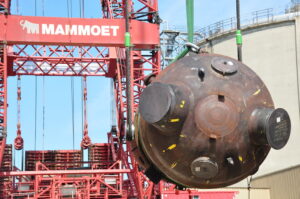
Within this context, Sarens, a global leader in heavy lifting, engineered transport and crane rental services, continues to play an active role in supporting the sector’s growth. Among its recent contributions is the lifting and installation of a 250-tonne (500,000 lb) walking portal for potash recovery at a new storage facility. Due to uneven leg lengths and an unbalanced weight distribution, the operation required a highly engineered solution involving multiple cranes and specialised high-capacity rigging to safely rotate and position the structure.
Sarens has also been involved in the expansion of the potash storage facility at Westshore Terminals in Delta, British Columbia. This strategic project, part of a USD 1 billion investment linked to BHP’s Jansen Mine, will transform the terminal into a mixed-use facility capable of handling up to 4.5 million tonnes of potash exports annually once completed in 2026.